

While creating actions for your custom applications.
Follow the following ordering pattern for organizing actions.
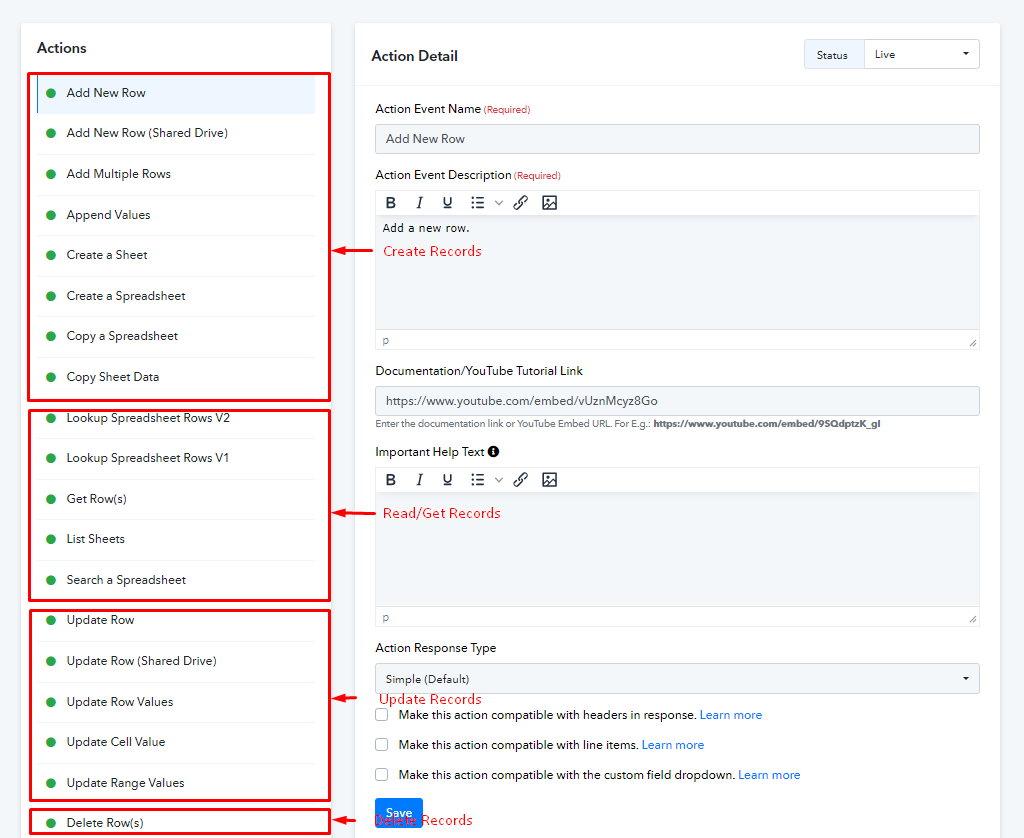
1. POST Requests (Create, Add)
All POST requests to create, add something will be listed on top.
The order of all the POST request will be based on the usage requirement.
For example:
Adding a New Row is Google Sheets is more important than Adding a new Sheet.
Reason: Add a New Row is frequently used action compared to adding a new sheet which a user will do only once.
2. GET Requests (Read, Search, Get, Lookup)
All GET requests to fetch data, search data, get data or lookup data will come after the POST requests.
For example:
Get Rows
Lookup/Search Rows
3. PUT Requests (Update, Change, Modify)
All PUT requests to update, change or modify data will come after the GET requests.
For example:
Update Data in a Row
4. DELETE Requests (Delete)
All DELETE requests to delete, remove data will come after the PUT requests.
For example:
Delete Row
Delete Spreadsheet
Note: If you are adding Add Row at number 1 on the POST request. Make sure to add Read Row, Update Row, Delete Row also at number 1 on the other request types.
Follow the following ordering pattern for organizing actions.
1. POST Requests (Create, Add)
All POST requests to create, add something will be listed on top.
The order of all the POST request will be based on the usage requirement.
For example:
Adding a New Row is Google Sheets is more important than Adding a new Sheet.
Reason: Add a New Row is frequently used action compared to adding a new sheet which a user will do only once.
2. GET Requests (Read, Search, Get, Lookup)
All GET requests to fetch data, search data, get data or lookup data will come after the POST requests.
For example:
Get Rows
Lookup/Search Rows
3. PUT Requests (Update, Change, Modify)
All PUT requests to update, change or modify data will come after the GET requests.
For example:
Update Data in a Row
4. DELETE Requests (Delete)
All DELETE requests to delete, remove data will come after the PUT requests.
For example:
Delete Row
Delete Spreadsheet
Note: If you are adding Add Row at number 1 on the POST request. Make sure to add Read Row, Update Row, Delete Row also at number 1 on the other request types.
Last edited:


